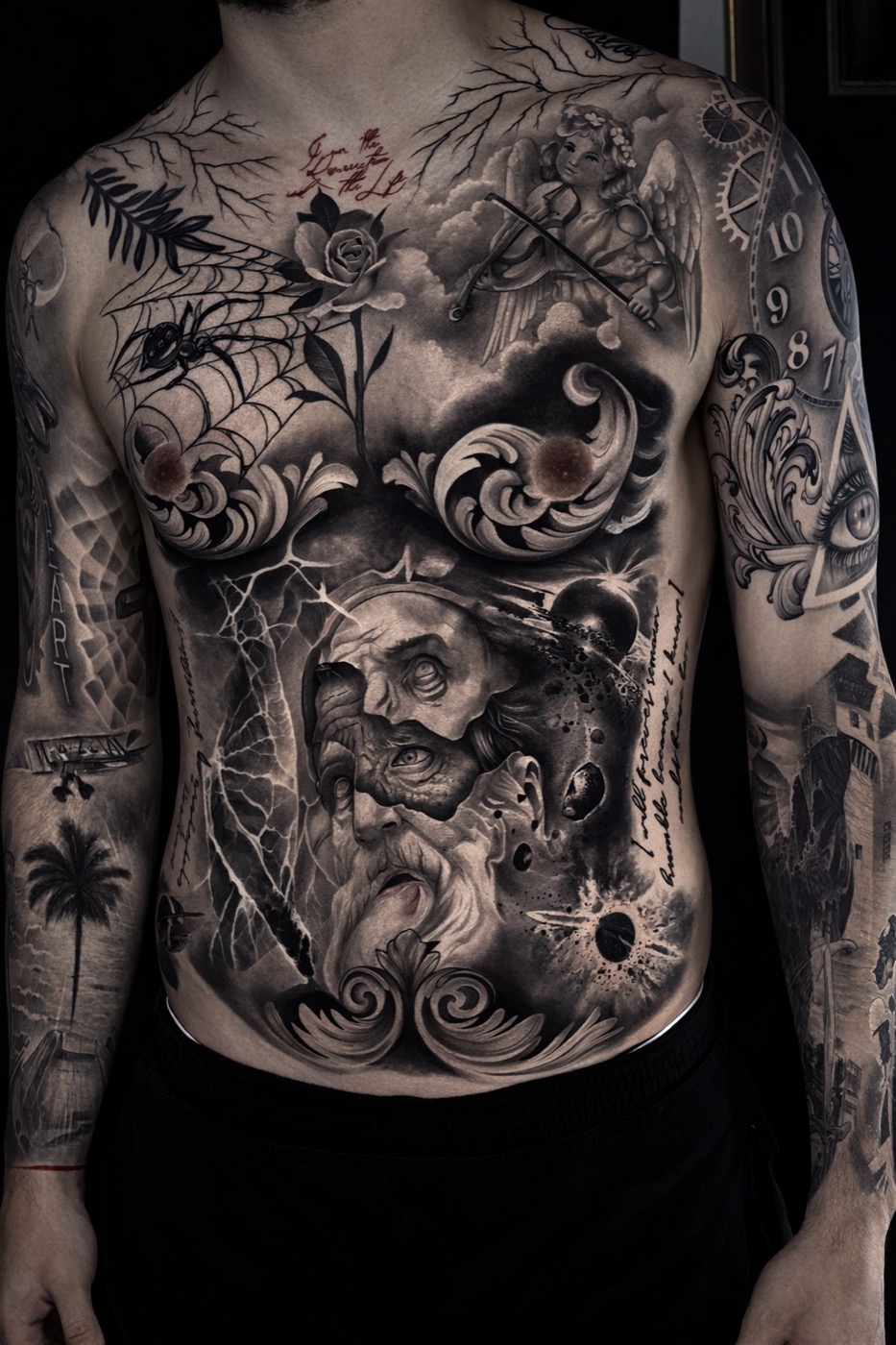
Most people choose a realism tattoo by looking at a photo of fresh work — skin still red, ink still wet, everything at its sharpest. That photo shows one moment immediately after the session. The real question is what it becomes on year five, year ten, the version you actually wear.
I create custom realism in the Denver metro area. Many important design decisions happen before the needle touches skin, alongside factors such as individual skin, technique and care. Here is how I think about it, and what you can do to plan a tattoo worth keeping.
Longevity is designed, not hoped for
Skin is not paper. It moves, it stretches, it softens, and over years the lines you put down spread microscopically. That spreading is not a flaw — it is physics. A well-planned realism tattoo accounts for it from the start; a poorly planned one fights it and loses.
The strongest pieces are built for the version of you that exists in ten years, not the photo taken the day they heal.
What that means in practice is that contrast, spacing, and size are not aesthetic afterthoughts. They are the structure holding the image together as it ages.
The four decisions that matter most
1. Placement follows the body
A realism piece placed against the natural flow of a limb will distort as you move and as the tissue changes. Placed with the anatomy — following the curve of a forearm, the plane of a shoulder blade — it stays composed. Before I draw anything, I want to know where it lives on the body, because that answer changes the drawing itself.
2. Size has to match the detail
This is where most regret starts. A portrait with real depth needs room. Compress an eye, a set of teeth, a spray of petals into too small a space and there is nowhere for the contrast to sit — the important features can become harder to distinguish. If you love a detailed reference, the honest conversation is often about making it bigger, not smaller.
3. Contrast is the thing that survives
Color and fine gradient are beautiful on day one, but it is the underlying contrast — the darkest darks against the cleanest lights — that keeps an image legible as everything softens. Strong contrast can help establish a clear visual structure. It does not guarantee how a particular tattoo will look in a decade.
4. Healing is half the work
Plan time for aftercare before booking and follow the instructions provided for your tattoo. Healing varies. For skin reactions or unexpected changes, seek medical advice; the American Academy of Dermatology explains tattoo reactions.
Why the planning conversation matters
None of this happens on a walk-in. It comes from a real conversation about what the piece means, where it goes, and how much room it needs to breathe. That is why my booking is inquiry-first and intentionally limited — not to be precious about it, but because the work that lasts is the work that got planned properly.
If you are thinking about a realism piece, the most useful thing you can bring me is not a fixed design. It is the meaning, an honest sense of placement and size, and the willingness to let the piece be built to last.
Laurent Alba is a custom realism tattoo artist in Centennial, serving the Denver metro area. To start a project, send your idea through the consultation form.
Frequently asked questions
How long does a realism tattoo take to plan?
For custom realism, planning usually spans a few weeks between the first inquiry and the session — enough time to compose the design around your body, agree on placement and size, and let the idea settle. Rushed decisions are where regret lives.
Do small realism tattoos age well?
Very fine detail packed into a small area is the first thing to blur as skin ages, because there is no room for the contrast to breathe. Small realism can work, but the detail has to be chosen, not crammed.
What makes a realism tattoo last?
Contrast, placement that follows the body, appropriate size for the detail, and healing care. A piece designed with longevity in mind reads clearly years later; one designed only for the photo on day one often does not.